

Your session recap
After the session, the next steps
That was a lot of ground to cover in an hour. Here's what matters most, in the order it actually happens, plus where to read more.
The short version
- How it works: held up in the inguinal canals 15 hours a day, the testicles sit at body temperature, two or three degrees too warm for the early stages of sperm production. Production pauses, and picks up again when you stop. The ring does nothing but hold the testicles up.
- The Toulouse studies (Dr Mieusset, running since the 1980s, with briefs worn 15 hours a day): almost everyone dropped below the threshold, everyone got their fertility back, side effects are common but mild and short-lived (irritation, discomfort over the first few weeks), no effect found on testosterone, mood or libido, and no established link with cancer. Small cohorts, followed for up to 4 years: encouraging, not yet solid. The 2024 review covers 26 studies and 1,675 men.
- TESTIS 2023: 970 people six months or more into the method. Six unplanned pregnancies, all of them before the threshold. A Pearl Index of 0.53 across the whole cohort, against 15 for condoms, 8 to 9 for the pill and 0.8 for the copper IUD in typical use.
- The threshold: under 1 million sperm per milliliter, the standard across every form of testicular contraception. Ordinary fertility runs between 15 and 300 million. Wearing the ring isn't what makes the contraception work. A semen analysis below the threshold is.
- Not for everyone: in recent cohorts, 7 to 25% of people don't reach the threshold. Nobody can explain why yet, or predict it in advance: the semen analysis tells you.
Where to read more: the method in 7 questions, the TESTIS thesis, the guide from the Collège de la médecine générale.
Start with the health check-up
Book an appointment with a healthcare professional to rule out contraindications. Your regular doctor, a gynecologist, a midwife, an andrologist, a urologist: what counts is finding someone willing to talk about it. The map of professionals shows who already follows the thermal method. Bring the guide from the Collège de la médecine générale along, it was written for doctors.
A baseline semen analysis, after 2 to 7 days of abstinence. It's the number every later test gets read against, and it matters again when you stop. Done at a lab, and reimbursed if you have a prescription. Ask for a repeat prescription to cover the follow-up tests and you won't have to go back for one each time. To find a lab or recommend yours: the labs form.
The order barely matters, but without a prescription the semen analysis comes out of your own pocket. An online consultation is enough to get one.
Finding your size
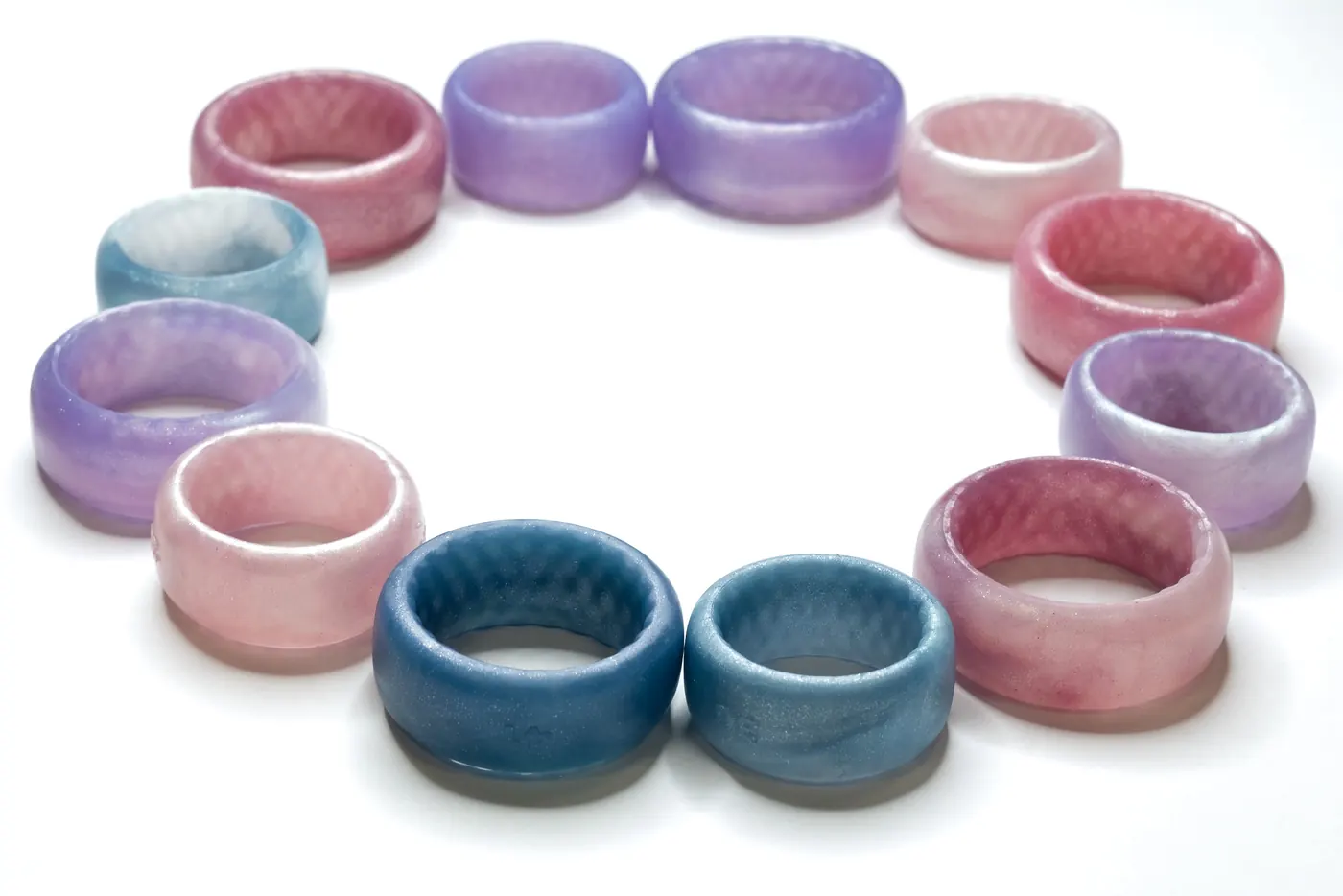
You find your size by trying rings on, never off a chart. Too small and the ring leaves marks and pinches; too big and it slips, and the testicles drop back down. There are 12 sizes, a millimeter apart in inner diameter, and you can barely see the difference from one to the next. That's deliberate.
- In person: you leave with one or two rings you tried on there and then, pay what you can, somewhere between €20 and €30 each.
- By mail: the fitting kit holds all twelve sizes and costs €70 plus shipping. Try them all, take your time. Keep two, send the rest back within the month using the return form, no hard deadline, return shipping on you. To get one sent to you: the-hot-spring.com.
- Why two: a range beats one exact millimeter. Two sizes land on the right fit far more often than one does, and some people keep both in rotation, one for sport, one for resting. Others go years on a single size.
- A ring that doesn't fit gets swapped, as many times as it takes: write to us, shipping is the only thing you pay.
The right size is the biggest one that still holds well enough.
Putting it on, in pictures: the illustrated guide. The part everyone forgets: pull the bottom of the ring back toward the perineum, so it seats as close to the body as it can.
Start slow
The classic mistake is going too fast. Build up the way you would with training, 7 to 10 days to reach 15 hours a day. The Otoko app (still in testing) will keep count for you if you want it to: request access.
- Less irritation: trim or shave the hair, use oil, cream or talc on the skin, and roll the top of a sock around the ring to cut down the friction.
- Discomfort: trying it on, you barely feel anything. A few hours in, a cramped or squeezed feeling can show up, the way new hiking boots do. Take it off as soon as it bothers you, and slow the build-up down. The body adjusts fast, and there's nothing to gain from pushing through.
- Sharp pain, or pain that lasts several days, is not normal. Take the ring off, and see a healthcare professional if it doesn't go away.
Day to day: 15 hours out of 24
- 15 hours a day in total, and never more than 9 hours off in a row. Simplest routine: ring on when you get up, off when you go to bed. Fall short of 15 hours one day and you can make the hours back the next night, to hold 15 hours out of 24.
- A break longer than 9 hours: write it down and bring it up. If it keeps happening, the protocol gets adjusted.
- Not overnight as a habit. You can lose the ring in your sleep with no way of counting the hours, and a nighttime erection prolonged by the ring is worth avoiding. For catch-up nights, wear briefs or a ring that doesn't grip the penis.
- More than 24 hours without it and you're back at day zero. Another method of contraception until a semen analysis comes back below the threshold, three months later. A sperm cell takes 74 days to develop, and nobody can put a number on the risk after a long gap. Consent is free and informed, which means you need the information.
- Peeing: the easiest thing is to take the ring off, or loosen it. Sport: sweat and bending make it slip, so take it off while you train and make the hours up later.
Check, never assume
Wearing a ring 15 hours a day for 3 months, or for 3 years, is not what makes the contraception work. A semen analysis below 1 million sperm per milliliter is.
- At 3 months: semen analysis. If it comes back below the threshold, a second one three weeks later confirms it. If it comes back above, wait three weeks and repeat. Still above: see a healthcare professional and look at other options.
- At least two tests below the threshold before you drop the other method, then a test at least every 3 months. More often means less risk: above that minimum, the pace is decided together.
- Ordinary fertility runs between 15 and 300 million per milliliter, and it swings widely from one person to another and over time. The 1 million threshold is the standard used for contraception.
Talking it through with a partner
Start here: the person doing the work of the contraception is not the person carrying the pregnancy risk. Talking closes that gap, and trust in the thermal method builds with time and with tests. Four things to settle together:
- The tests: how many before unprotected sex, how often after that. The more tests behind you, the more trust there is.
- The wearing routine: more or less than 15 hours is a joint decision. Less than 15 hours means less chance of being below the threshold at 3 months.
- The number you aim for: 1 million, or stricter, 500,000, 200,000, zero. All of it is on the table.
- Whether to combine with another method, and thinking of contraception as something that shifts over time: nothing is set in stone, the plan can change.
And talk about a possible pregnancy before there is one. It leaves you the time and the emotional room you'd need.
Returning to fertility, one day
Fertility usually comes back in 4 to 6 months, two production cycles, and up to nine months for a semen analysis that is normal on every count. Two things worth knowing:
- Tobacco, alcohol, drugs, not enough sleep, saunas, some medications: anything that weighs on fertility can stretch that out.
- No pregnancy until the numbers are back to normal. Another method while things recover, and a semen analysis in the normal range, often more than 4 months out, before trying for a child.
Keeping in touch with Otoko
- The Otoko app, still a test build: it counts your hours and sends the reminders. Request access.
- The Otoko survey will come your way now and then. Nobody has to fill it in, but it's what builds what we actually know about the thermal method.
- The community: Discord for your questions, Instagram to keep up with the workshops.
- Making your own rings: the DIY making workshops, pay what you can, where you cast your own silicone rings and take them home.
- Another session, with a partner this time, or for someone it would help: book a slot.
- Telling us how it goes. One account of how it actually went, good or messy, does more for the thermal method than any argument.
Supporting Otoko
The session is pay what you can, with no minimum. And no minimum means zero: you can come for free, and nobody keeps track of who gives what. Forty euros is the figure we suggest, roughly what covers the time of the person running it. Otoko has worked this way from the start: people with more give a little more, people with less give less, and money should not be part of the decision when you choose your contraception. The amount is yours to change on the payment page.
Useful links
To date, there is no certified contraceptive device for testicular contraception. Handmade tools are experimental, and their effectiveness and safety have not been demonstrated. They have no contraceptive effect as such. Jockstraps should be considered underwear, and rings as simple penile rings adapted to testicular elevation for daily wear. Anyone who wants to can experiment with the method, in full knowledge of the risks and with medical follow-up.