The project

Thermal contraception, developed by its community.

For now, the thermal method is still experimental. Yet the results are striking: it's effective, reversible, and its side effects are minor compared with the more common contraceptive methods. We're a community of people who use it, and we're the ones exploring it and working out how it works.

01 · Equity

Sharing the contraceptive burden.

For a teenage girl, booking an appointment to talk about contraception is almost a rite of passage. For men, it's the exception. There's a logic to people who can get pregnant being in charge of their own safety: it's their body on the line. The gap is still huge, and it's no secret. Otoko works to get men involved in turning that around.
02 · Community

The method belongs to the people who practice it.

It doesn't flow down from an institution to its users. It travels peer to peer, through workshops and talking circles, and the people who take it up shape it in turn. Designs, protocols, and resources are published under a free license, and collectives run their own workshops in France, Belgium, Germany, and Canada without asking Otoko for anything.

03 · Support

Support along the way, for both of you.

Bringing your sperm concentration down and building trust with your partner are two different things. The first one can be measured. The second one has to be built, and nothing measures it, even though it's the one that decides everything. Otoko supports both, and puts you in touch with healthcare professionals trained in the method, mostly in France.

Research

The research is still ongoing, and we say so.

There's little clinical data so far, and the protocols written in the 1980s aren't as robust as today's. So the current research can't settle every question. Otoko gathers the studies and grades them by level of evidence, runs a follow-up survey with the people who use the method, and measures and documents the rings. Producing this data is part of the work, not something to wait for first.

The studies, in the English guide

The method

Body heat puts sperm production on pause.

No hormones. Reversible. You can check it with a lab test or at home.

How it works

Sperm is produced in the testicles, a few degrees below body temperature. When the lower part of the ring is pulled back toward the perineum, the testicles rise into the inguinal canals and stay held there. Developing sperm don't survive at that temperature.

The documented protocol is to keep the testicles lifted at least 15 hours a day, every day, during waking hours. A single day off is enough for the effect to no longer be guaranteed. Sperm production stops within the first few days, but contraception only counts as reached after about three months, and only if two tests show it: fewer than 1 million motile sperm per milliliter, on two semen analyses three weeks apart. (Soufir and Mieusset 2012, practical guide, protocol described for briefs.) In the founding Toulouse study, that threshold was reached in 3.5 months on average. (Mieusset and Bujan 1994, 9 couples.)

Keep another method until those two analyses. After that, the follow-up goes on: one semen analysis a month until month six, then one every two months. (Soufir and Mieusset 2012.)

A contraceptive method is never just a device. What makes thermal contraception work is a protocol: understanding what's happening with your fertility, knowing how to check it, knowing how to wear the ring, and knowing how to talk about it as a couple. That last part is the one no instructions ever cover.

The data so far

  • Reaching the threshold Some people never reach the threshold. Depending on the study, 81.8% to 92.6% reach it; the highest figure comes from a self-reported survey that only counts use beyond six months. Baron 2025, 66 people; Béraud 2023, 31 people; TESTIS, Guidarelli 2023.
  • Side effects and satisfaction 94.8% of respondents report at least one side effect, mostly on the skin, and 86% say they're satisfied. Both figures only count use beyond six months. TESTIS, Guidarelli 2023, N=970, self-reported.
  • Return to fertility After stopping, published times range from 1.8 to 18 months depending on the study. In the CRT-REVERS follow-up, the median time to pregnancy is 5 months among 179 respondents, and 13.6% of the 66 people analyzed were still below normal values more than three months after stopping, with no follow-up beyond that. The guide limits use to four years, and you need another method from the day you stop. Rogier 2024; Mieusset and Bujan 1994; Baron 2025; Soufir and Mieusset 2012.
  • Hormones At 15 hours a day, no major change in testosterone, FSH, or LH. Testicle volume drops by less than 20%, and comes back within a year of stopping. Mieusset 1996, review by the Toulouse team.
  • Forty years of research Marthe Voegeli, a Swiss doctor working in India, documented heat as a way to prevent pregnancy as early as the 1930s. From the 1980s, Dr. Roger Mieusset took up the question at Toulouse University Hospital and followed his patients for three decades.

The ring has no contraceptive effect

The ring doesn't heat up, and it does nothing to fertility by itself. It holds the testicles up, and body heat is what stops sperm production. Rings and jockstraps are tools for testicular elevation: they have no proven contraceptive properties, and they're best thought of as underwear or simple penis rings, made for everyday wear. No trial has ever looked at the silicone ring. (Baron 2025.)

The protocol is what makes the contraception, and semen analyses are what confirm it. Until your concentration is below the threshold on two analyses three weeks apart, keep another method.

In practice

Putting the ring on, step by step.

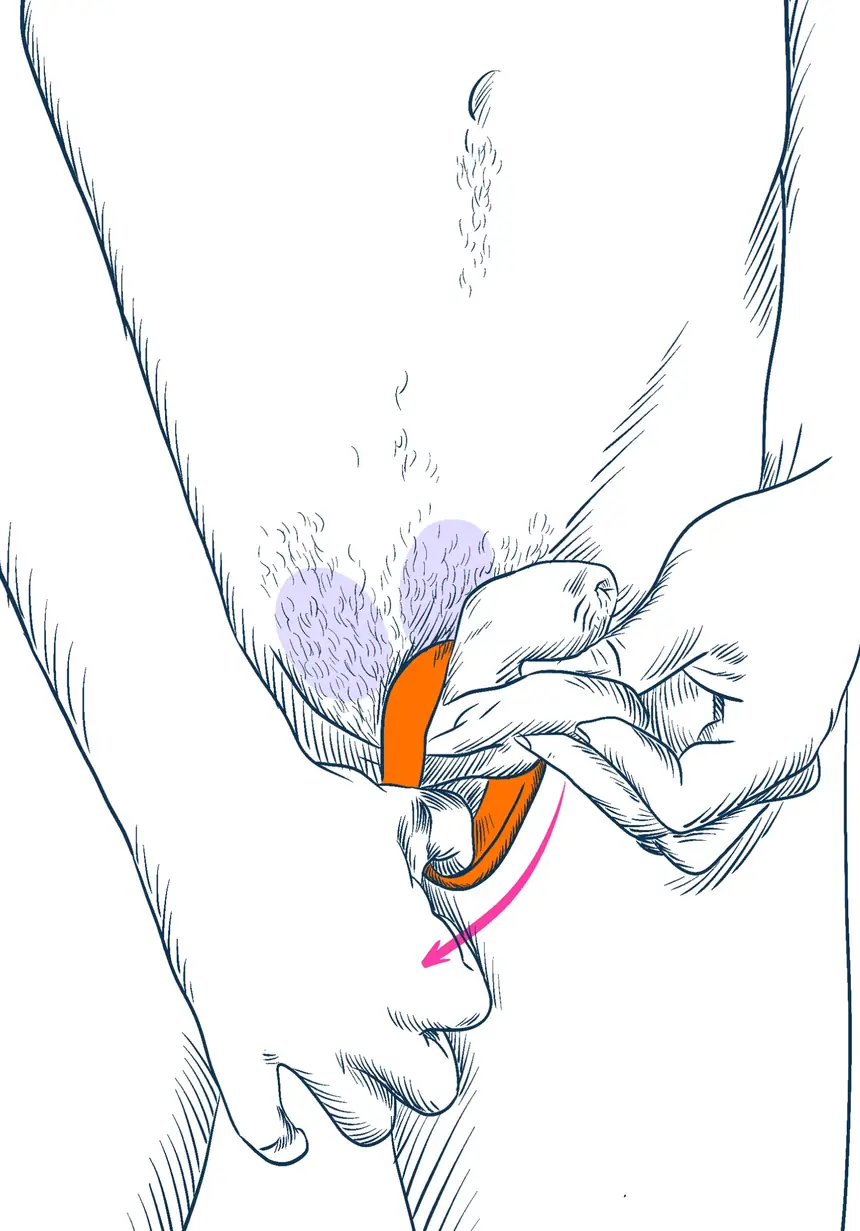
The step people miss most often is pulling the ring back toward the perineum. That's the move that lifts the testicles and keeps them up: without it, the ring stays in place but wearing it does nothing. If in doubt, that's the one to redo.

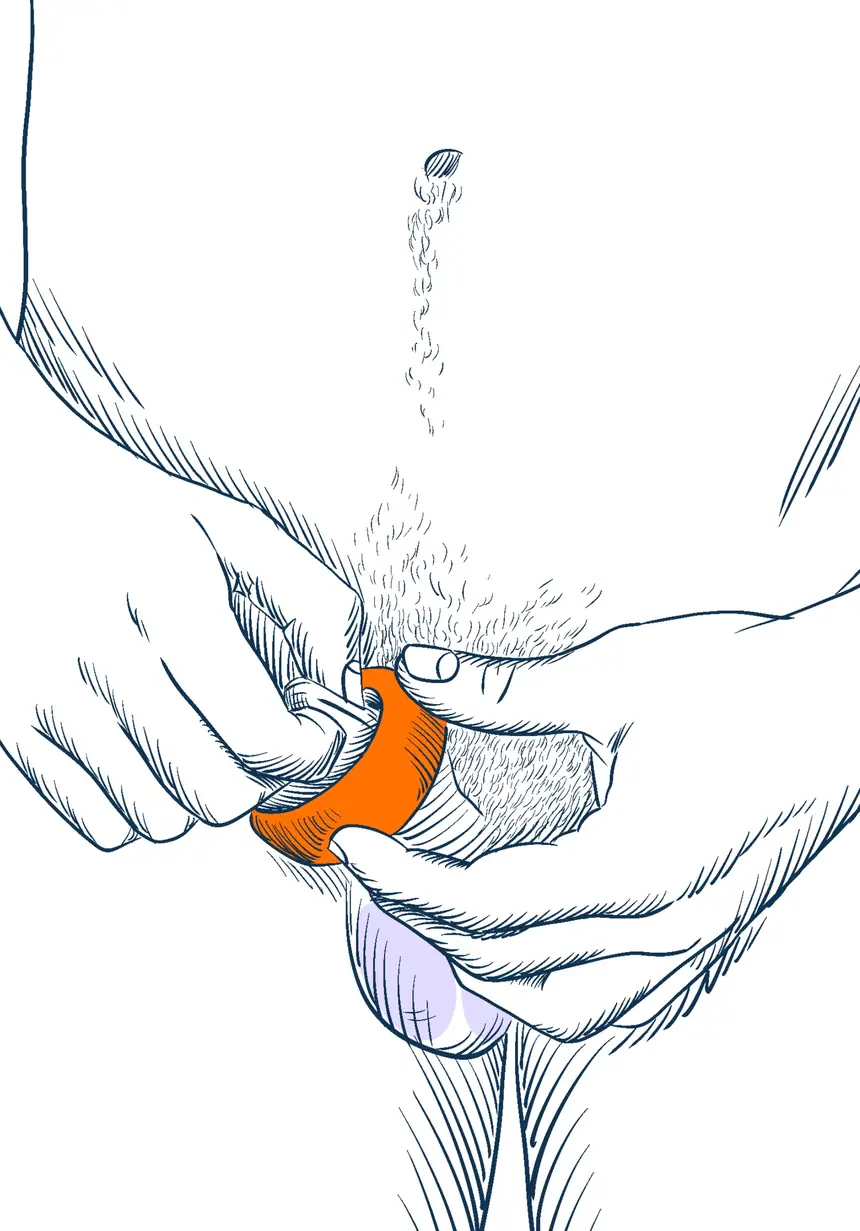
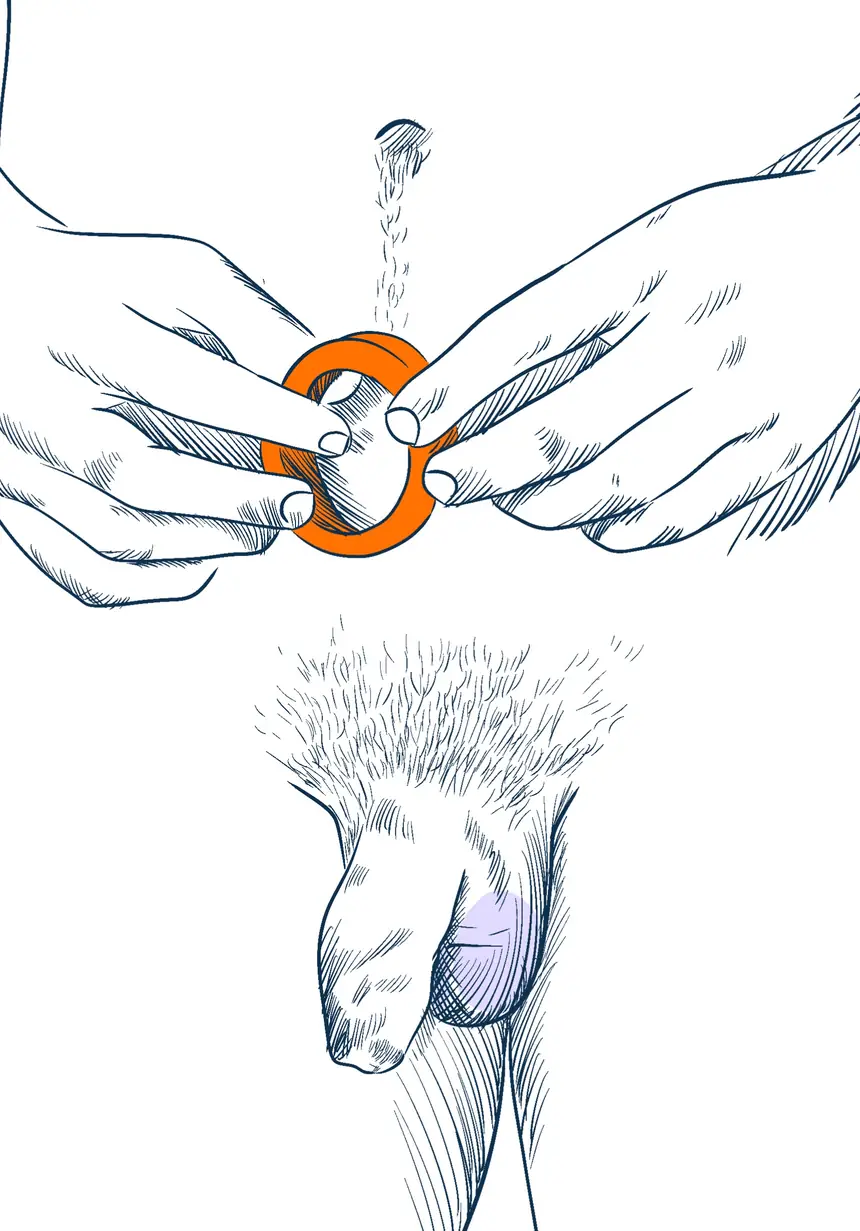
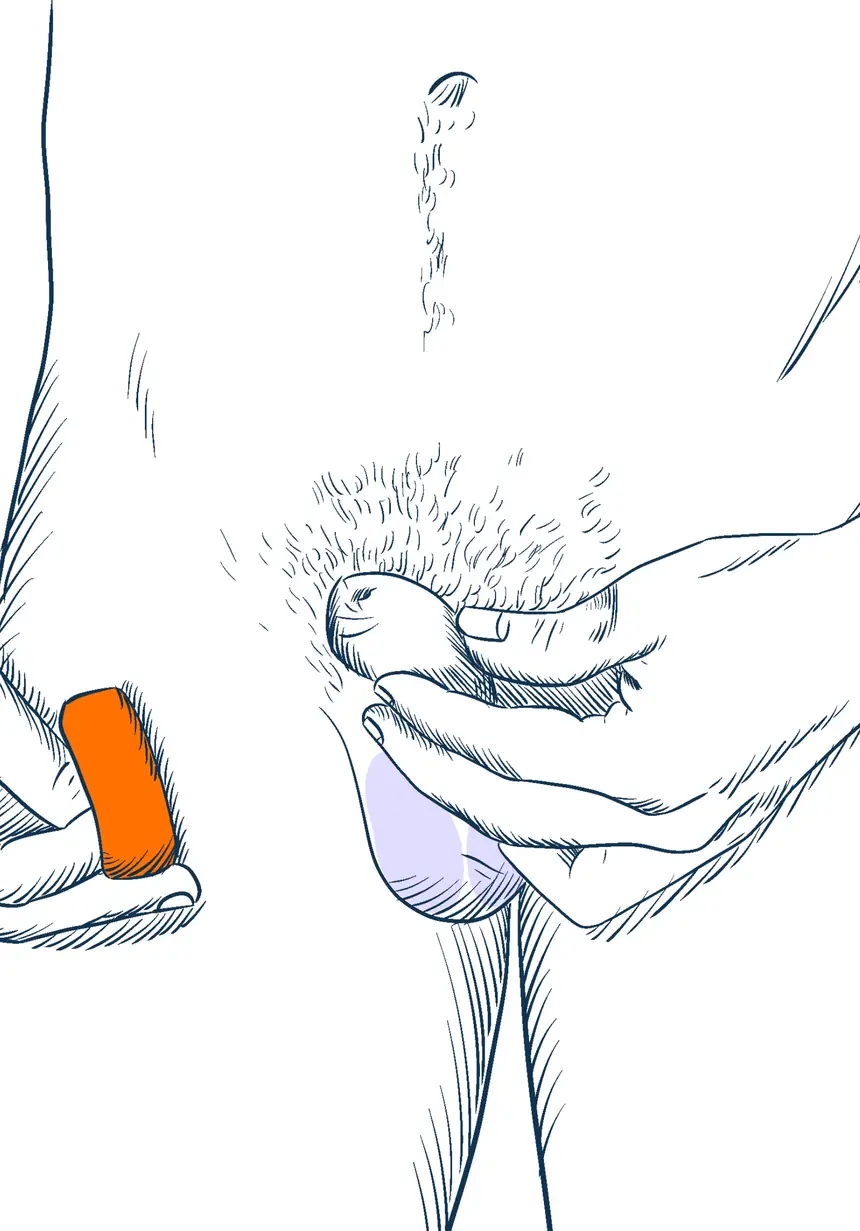
  1. A silicone ring next to a hand, testicles hanging low.
    Step 1 of 9

    Get the ring ready

    Start with the middle sizes of the kit. Wash the rings with soap before each use. At the start, the testicles are in the scrotum, hanging low.

    If you have to pull really hard to get the ring on, the size is too small.

  2. One hand pulls the penis upward, the other holds the ring open between the fingers.
    Step 2 of 9

    Hold the penis, line up the ring

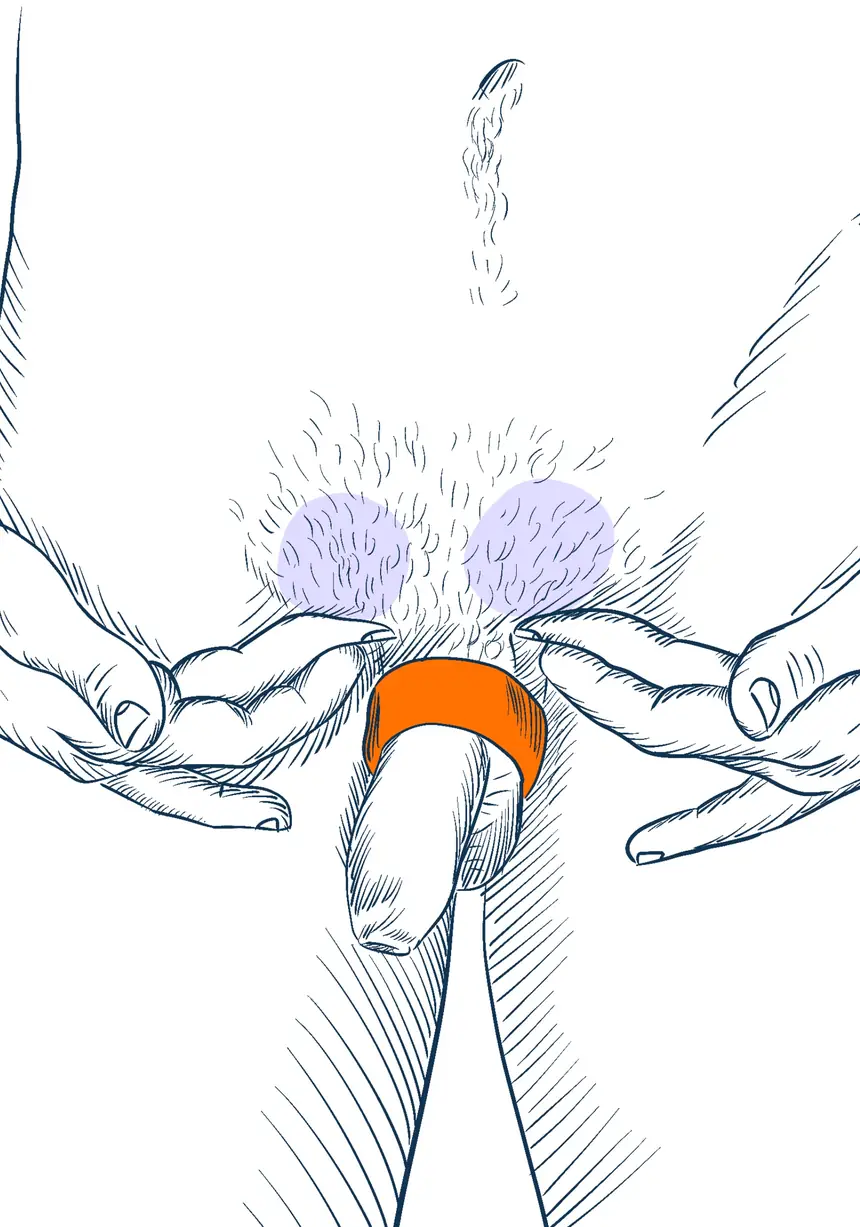
    Hold the penis in one hand and pull it upward. With the other hand, position the ring, held open between your fingers.

  3. The ring slides along the penis until it touches the scrotum.
    Step 3 of 9

    Slide the ring to the base

    Slide the ring down to the base of the penis, until it touches the scrotum.

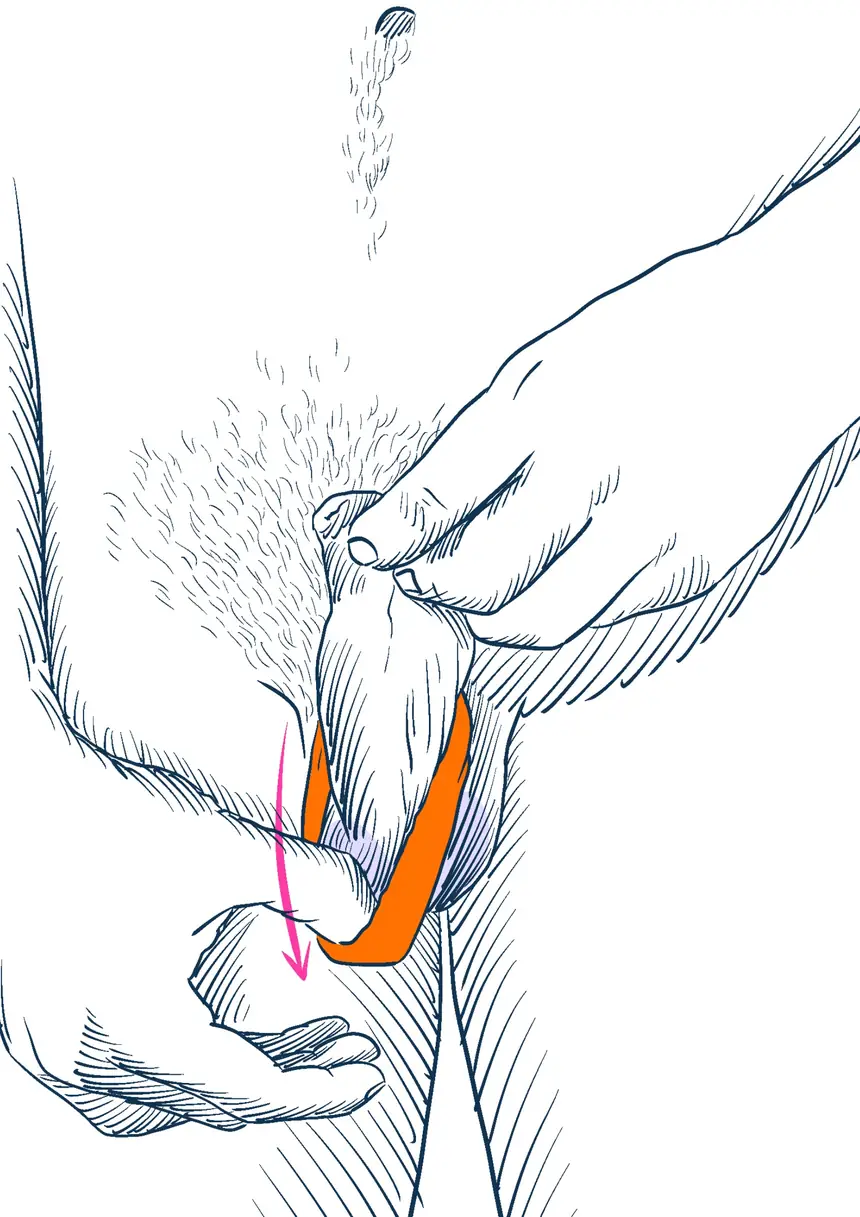
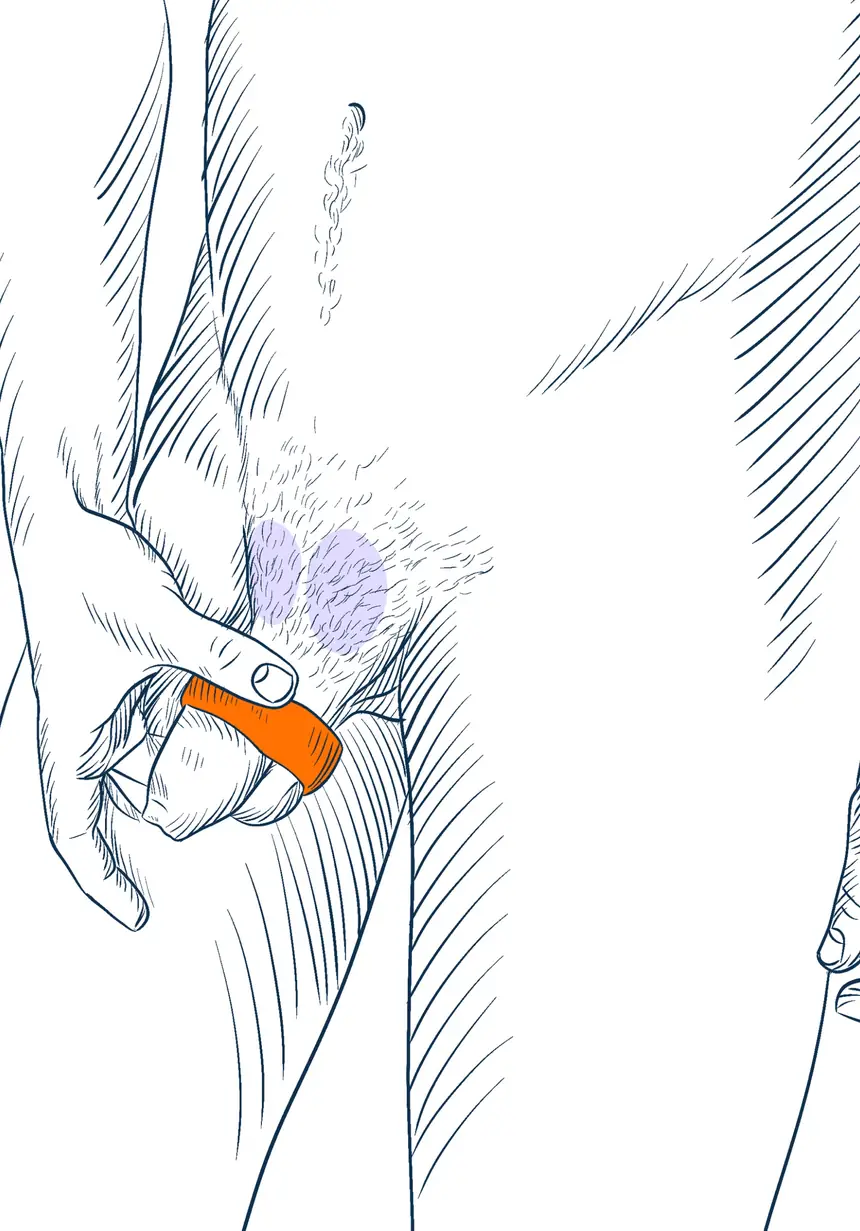
  4. One hand stretches the ring downward while the other brings the skin of the scrotum through it.
    Step 4 of 9

    Bring the scrotal skin through

    Pull the penis upward with one hand, and with the other, stretch the ring downward. The hand holding the penis then gently brings the skin of the scrotum through the ring. The penis and the scrotal skin go through, and the testicles stay on the body side.

    This often takes a few tries at first, and you can start over as many times as you need.

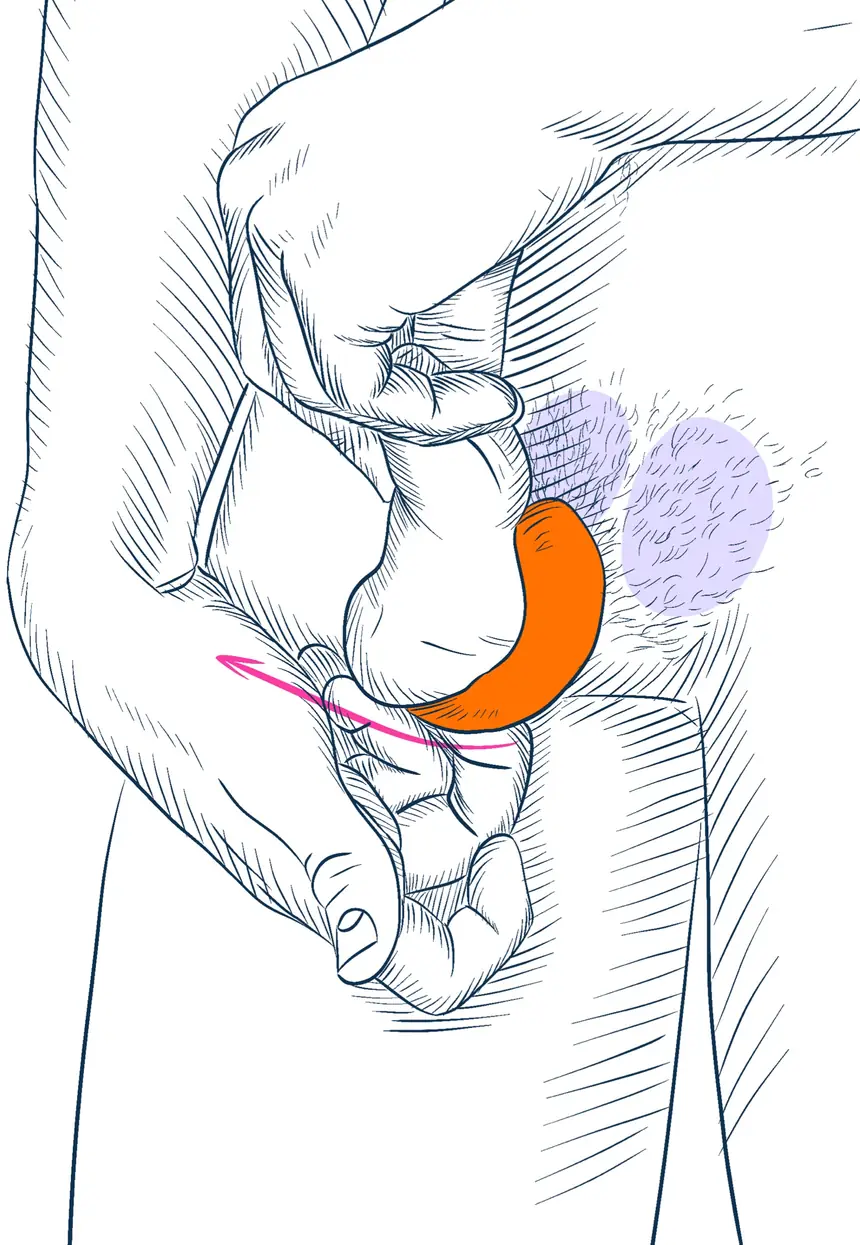
  5. The lower part of the ring pulled back toward the perineum, testicles lifted against the body.
    Step 5 of 9

    Pull the ring toward the perineum

    This is the most important step, and the one people miss most often. Take the lower part of the ring and pull it back, toward the perineum. The testicles then rise into the inguinal canals, inside the body, and the ring settles behind the scrotum, as close to the body as possible. The testicles stay on the body side and never go through the ring.

    Without this step, the ring stays in place but the testicles drop back down, and wearing it does nothing.

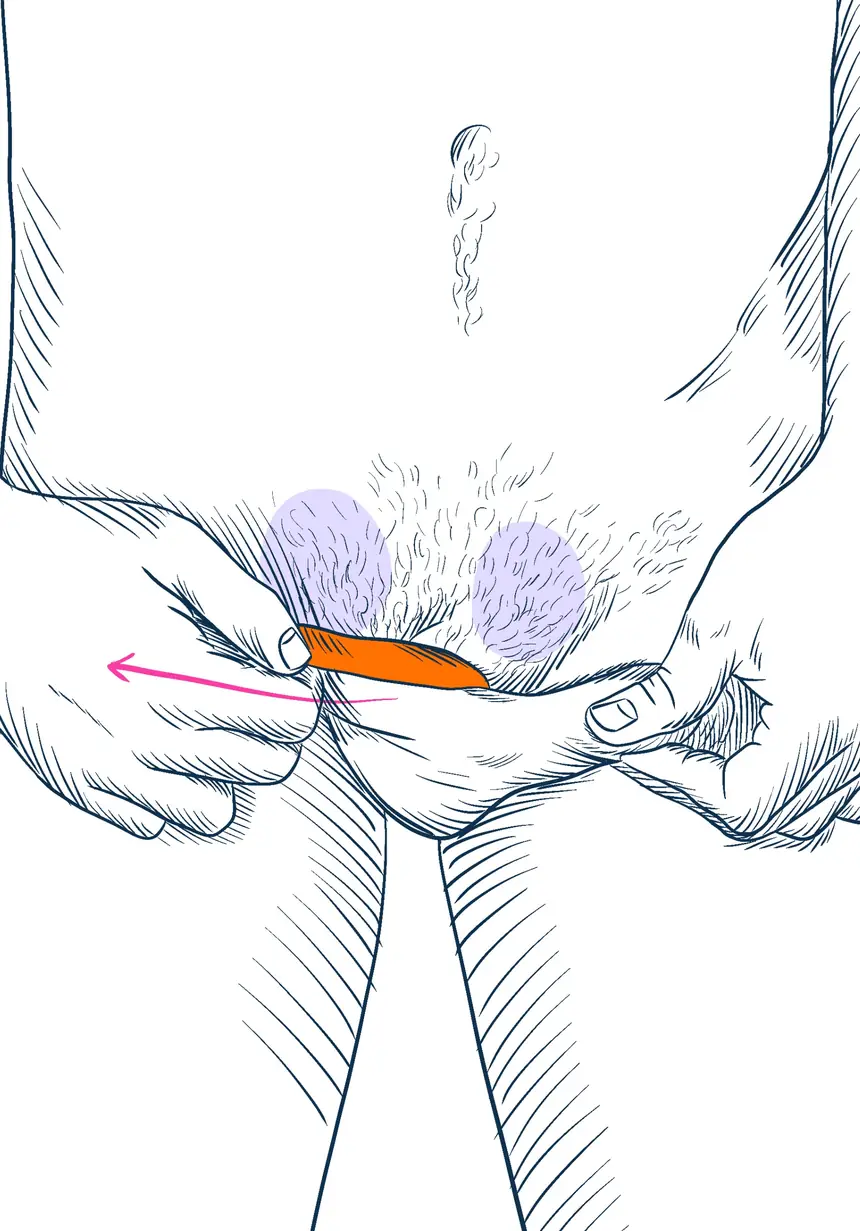
  6. Side adjustment of the ring, the penis pulled one way and the ring the other.
    Step 6 of 9

    Adjust the position

    Four similar moves settle the ring against the body. Pull the penis to the right and the ring to the left, then the other way around. Or pull the penis down and settle the ring closer to the pubic bone and the skin. These moves improve the hold and the lift.

  7. Front view showing the testicles above the upper part of the ring.
    Step 7 of 9

    What a good hold looks like

    The testicles sit above the upper part of the ring. If they don't, don't panic: the position gets better with time and practice. The higher the testicles, the more effective it is.

    If you're not sure about the lift, redo step 5: pull the lower part of the ring toward the perineum.

  8. A hand tugs on the ring to check that it doesn't slip.
    Step 8 of 9

    The hold test

    Once the ring is on, tug on it gently: it should stay where it is. A few squats or small jumps let you check it while you move. The ring should stay put without slipping on its own.

    If the ring slips on its own, or the testicles drop back down or slip back through, the hold isn't right and the size is too big.

  9. The lower part of the ring pulled outward to take it off.
    Step 9 of 9

    Take the ring off

    Take the lower part of the ring and pull it outward. The testicles drop back down, and the ring comes off easily.

    When you pee, take the ring off, or at least loosen its lower part.

1 / 9

Illustrations by May. The same drawings make up the ring guide handed out at workshops. The full practical guide, in English.

Get started

Three ways to start.

It all starts with a conversation. Everything else gets decided afterward, and nothing happens without it. Not sure which one fits you? The Start page helps you choose in two questions.

Recommended

One-on-one information session

One hour with Sam on a video call, in English, pay what you can. How the body works, the scientific sources, the protocol step by step, everyday life with the ring, and the agreement to work out with your partner or partners.

In a group

Ring-making workshop, in French

Three hours in a group: in Pantin, pay what you can, or with a collective elsewhere in France, at its own price. You make your own silicone rings, try on sizes until you find the right one, and meet other people who use the method.

Near you

Meet a local collective

Independent collectives run their own workshops and talking circles with Otoko's open resources, mostly in France. The map lists them, along with healthcare professionals who follow the method.

Follow-up with a healthcare professional isn't optional. It's part of the method.

A semen analysis is what tells you whether you're below the threshold, and a healthcare professional is the person who follows you through it. Without that follow-up there's no contraception, just a ring you're wearing. The map lists doctors, midwives, and urologists who know the thermal method, mostly in France. Outside France, a doctor near you is the place to start.

Find a healthcare professional

Good to know

The limits, no sugarcoating.

  • Our rings are prototypes without CE marking. They're handmade, cast in platinum-cure silicone. Certification is being considered; no legal process has started so far.
  • The object itself has no proven contraceptive properties. The ring holds the testicles up. Body temperature is what pauses sperm production, and semen analyses are what confirm contraception.
  • Lab tests are the only source of truth. Only they can tell whether the method is working as contraception. No page on this site, no content, and no app replaces follow-up with a healthcare professional.
  • The European and American andrology societies are waiting for large trials before recommending the method. Their 2024 guidelines (EAA and ASA) advise against heat as contraception until large trials exist. They acknowledge that lifting the testicles prevented pregnancies in the Toulouse studies, and they reserve their position. Wang et al. 2024, Andrology.
  • Scientific work is ongoing. The available studies are small, and the state of the research doesn't allow solid conclusions on every point. Every claim on this site comes with its source.